
A disappointing turnout for the first night of the meet. Car problems, illness, lost wallets and other commitments meant that only four people managed to arrive on the Friday night. However plans were hatched and the weekend saw a variety of activities fit for recording in the ‘book of climbs’.
On a bright a breezy morning Captain Brookes set off with Cabin Boy Bob M and First Mate Fiona C to cruise the bountiful waters of Loch Gairloch( an Geàrr Loch) . This translates as ‘the short loch’ and a quick look at the charts show that at around 6 miles (9.7 km) long by 1.5 miles (2.4 km) wide it certainly is. The sea log (big red book) records ‘the weather forecast suggested lots of rain so went yotting on good ship Voljo with the [press ganged?] crew. Didn’t climb a lot of mountains but saw a lot, got rained on and had a good breeze’
Zippy, Dan, Sheena and Penny TWD decided to ascend Slioch as it was one of only 10 Munros left to bag on Zippy’s round four and Penny’s round two of the aforementioned hills. Forecast was for persistent rain but they were pleasantly surprised to only get a little damp and have pretty good views for much of the day. However gusty winds and cool temperatures near the summit forced a hasty retreat back to sheltered ground where some culinary delights were withdrawn from rucksacks. The menu as recorded by Zippy consisted of “Graeme – malt loaf, Dan – a whole baguette stuffed with sardines fresh from the tin (very smelly), Sheena – a ham and cheese roll followed by half a Soreen, Penny TWD – scraps”. The views were good with the return plod back to the car seeming longer than the way out. A good day on the hill.
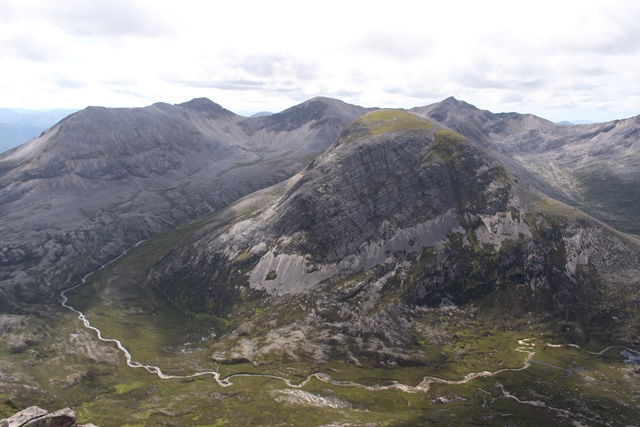 Saturday night in the bunkhouse was a lively affair after the arrival of several more members. We were treated to various music recitals from Jake (guitar and voice) and Petra (clarinet).
Sunday was a day of walking and climbing, which are most suitable activities for a refined institution such as the MMC. Dan and Sheena dithered around for a bit then decided to ascend Meall a’ Ghiuthais (Hill of the Pines). “We walked up the pony track to the bealach between our hill and Ruadh Stack Beag, then headed straight up the steep slope over screes to our summit. Fantastic views of Loch Maree and the Torridon hills. More culinary delights – same as previous day for Dan (still smelly) [that’s the food choice rather than the consumer of the food] and a macaroni pie for Sheena. The day was finished off nicely with sustenance in the form of tea and lemon cake from the Tipsy Laird Cafe in Kinlochewe.”
Ben, Shane, Andy B and Petra went climbing for the day at Stone Valley, near to the Red Barn (which is actually green). Andy B takes up the tale…. “for a nostalgia trip Petra led me up Open Secret, which seemed harder than it did 26 years ago [first ascent by A Brookes], but lovely sunshine and great climbing. Shane and Ben did Bald Eagle. More routes were completed at Rum Doodle Crag. I led up Roman Wall (S) and Petra led Rum Doodle arête (HS). Shane and Ben went to Blood Feud (E1). The drizzle was on as everyone arrived back at the cars and agreed it was a great day out”.
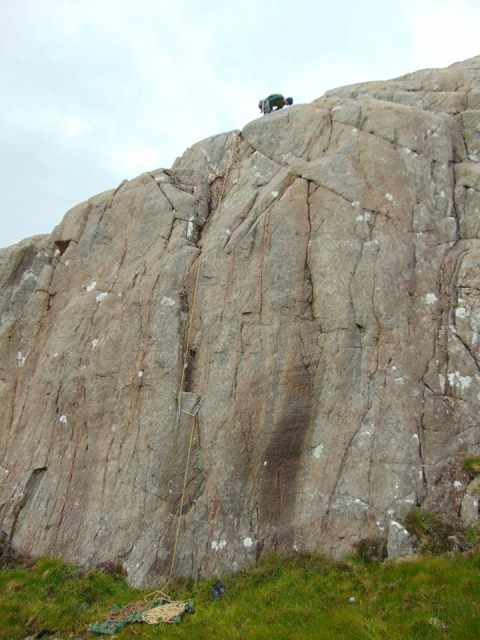 Shane’s story – “I led Bald Eagle (HVS) with Ben on second on fantastic rough gneiss on a beautiful sunny morning. Next was a two pitch E1 5b. Ben’s hangover [heard that one before] had got the better of him so I led both pitches. The last one was Playtime Wall (E2 6a),which is basically a high ball boulder problem – straightforward after reaching the ledge. Unfortunately the drizzle began and the midges began to gather which curtailed any more adventures for the day.”
Bored of being a Cabin Boy, Bob and First Mate Fiona decided to tackle Beinn Liath Mhor in the Achnashellach Area. Bob says “after finding a place to park the car, it was a long slog up to the base of the hill. Running short of water we filled up from the runoff from the rock before the steep climb to the south summit of the Beinn. The sun was still shining as we went along the ridge to the main summit, but the clouds were building in the west. Descending to the bealach the rain was slanty and we were in two minds about heading up Sgorr Ruadh, but worked out it would only take an hour. So off we went to the top arriving about five. Back down in the mist arriving at the car about eight”.
Every wondered what you may be walking on? – The rocks underneath are the foundations of the landscape so it’s worth knowing a bit about them to appreciate the hills that bit more. The area around Kinlochewe is well known (in geological circles) as a location which displays a huge variety of rocks in both types and age. It represents in a small area many of the rock sequence that is to be found over much of the NW Highlands.
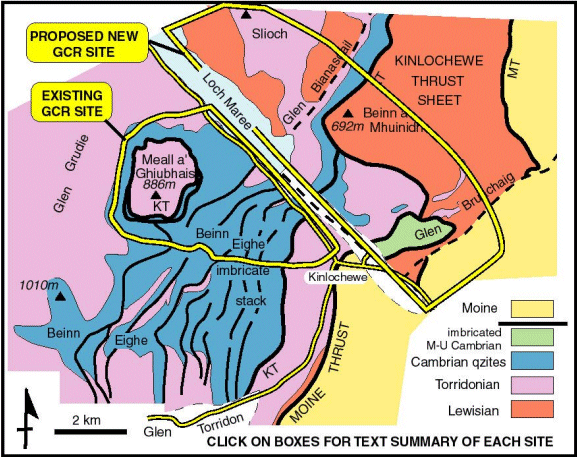
Lewisian rocks. The oldest rocks of the NW Highlands are up to 3 billion years old and are known as Lewisian rocks. They are the oldest rocks in Scotland and some of the oldest in the world. The Lewisian rocks formed over a huge span of time (up to 2 billion years), through burial, compression, folding and heating of large amounts of cooled molten rock, and much smaller volumes of muddy, sandy and rare carbonate (e.g. limestone) sediments.
Torridonian rocks. By around 1 billion years ago, the Lewisian rocks were already ancient and had been eroded down into a hilly landscape. Across this landscape huge rivers flowed, around 1200 to 800 million years ago, depositing layers of red sandstone, muds and pebbly conglomerates. This sequence of river sediments is known as the Torridonian, and once formed a blanket up to 7.5 kilometres thick covering the ancient Lewisian landscape.
Like the Lewisian, the Torridonian rocks were later partly eroded away. Today much of the old Lewisian landscape has been re-exhumed with hills of Torridonian rock, such as Slioch and Suilven, perched on top. Around 550 to 500 million years ago in the late Cambrian and early Ordovician geological time periods, the area was covered by a shallow sea and a sequence of pure white sands (now quartzite), some muddier sediments (now soft, nutrient rich Fucoid beds), and finally a thick sequence of carbonate rocks (now magnesium-rich limestone know as Durness dolomite) were laid down on the eroded surface of Lewisian and Torridonian rocks. These Cambro-Ordovician sediments have now also largely been eroded away. Today they are only found in a thin strip along the east edge of the area, adjacent to the Moine Thrust, and on the tops of hills such as Beinn Eighe and Foinaven.
The photo of Slioch clearly shows the boundary between rock of different ages -this is known as an unconformity A paleo landscape is an ancient or previous landscape.

Author: Sheena
Pictures: Dan M, Ben W
Geological images: University of leeds, School of Earth and Environment